

How to Choose the Right Bangle Size: A Complete Sizing Guide
To find your bangle size, measure the widest part of your hand across the knuckles, with your thumb tucked in, rather than your wrist. Bangles need to slide over your hand to be worn at all. Compare that measurement to the diameter chart further down this guide, or match it against a bangle you already own that fits comfortably. Getting this right matters more with bangles than most other jewellery types, since a rigid bangle that doesn't fit simply cannot be worn. There is no clasp or adjustable strap to compensate for a size that's slightly off.
Why bangles are sized differently from other jewellery
Most jewellery, including rings, necklaces, and bracelets with clasps, can be adjusted or has some flexibility built in. A bangle is different. It is a rigid, closed (or near-closed) loop that must pass over the widest part of your hand before settling comfortably on your wrist. This is why bangle sizing is based on your hand measurement rather than your wrist measurement, even though the bangle ultimately sits on your wrist once worn

Why hand size matters more than wrist size
Your hand, measured across the knuckles with your thumb tucked in to make it as narrow as possible, is almost always wider than your wrist. A bangle sized only to your wrist would be far too small to get on in the first place. Always measure your hand at its narrowest possible width, not your wrist, when choosing a bangle size.
How to measure your hand for bangles, step by step
- Bring your thumb and little finger together to make your hand as narrow as possible. This is the position your hand will be in when sliding the bangle on.
- Wrap a soft measuring tape (or a strip of paper or string, which you can then measure against a ruler) around the widest part of your hand, just below the knuckles.
- Note the measurement in centimetres, keeping the tape snug but not pulled tight.
- Divide that number by 3.14 (pi) to convert your hand circumference into an approximate diameter. This figure matches most bangle size charts, since bangles are sized by their internal diameter, not circumference.
How to size using a bangle you already own
If you have a bangle that already fits comfortably, this is often the easiest and most accurate way to size a new purchase.
- Lay the bangle flat on a table or hard surface.
- Measure the inner diameter from edge to edge, in a straight line through the centre (not around the outer edge).
- Use that measurement as your reference size when ordering new bangles, keeping in mind slight variations between styles noted below.
General size reference
|
Hand measurement (around knuckles) |
Approximate bangle diameter |
|
18–19 cm |
2.4 inches (small) |
|
19–20 cm |
2.6 inches (medium) |
|
20–21 cm |
2.8 inches (large) |
|
21 cm+ |
2.10 inches+ (extra large) |
These are general industry ranges intended as a starting point. Always check the specific size listed on each individual product page, since sizing can vary slightly between bangle styles, materials, and manufacturers
Does sizing differ between glass and metal bangles?
Yes, in a few practical ways. Glass bangles are rigid and completely unforgiving on size. Because glass cannot flex at all, an undersized glass bangle cannot be forced over the hand without risk of breaking, and potentially injury. Size slightly generously if you are between measurements. Metal bangles, particularly those without a fully closed loop, sometimes have a small amount of give or an opening that allows minor adjustment. This makes them somewhat more forgiving if your measurement falls between two standard sizes.

What if I'm between two sizes?
Always choose the larger size. A slightly loose bangle is a minor comfort issue and can be worn with a bit of care; a slightly tight bangle may not go on over your hand at all, particularly with rigid glass styles. This is especially important to keep in mind when buying as a gift for someone else, where you can't test the fit in person.
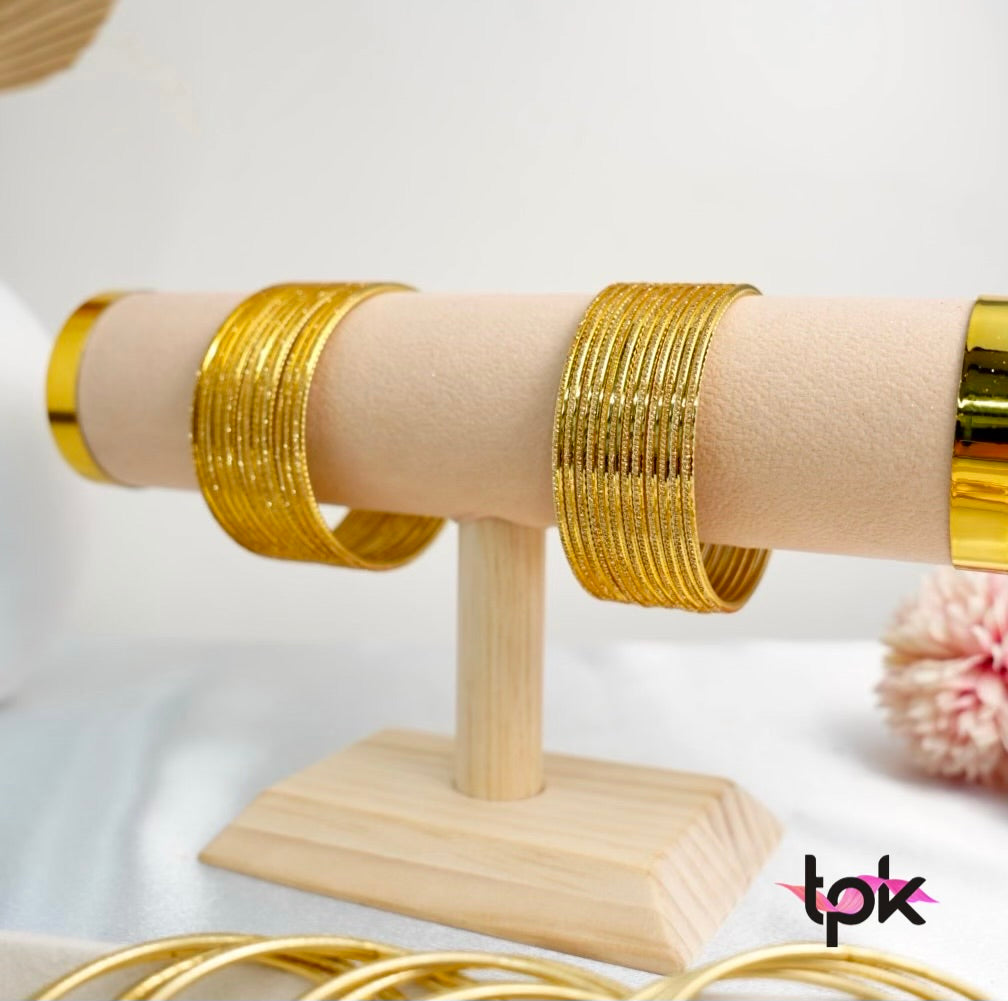
We stock a beautiful range of traditional bangles and jewellery, perfect for festive occasions, weddings, celebrations, and everyday ethnic styling. Explore our handpicked collection and find the perfect bangle set to complement your traditional look.


How many bangles should I buy for a full set or stack?
This comes down to personal style and the occasion. A subtle everyday look might use two to four bangles on one wrist, while a festive or bridal look often uses a full stack of eight, twelve, or more coordinated bangles per wrist for a fuller, more traditional appearance. Many of our sets are sold in pre-coordinated counts (such as sets of 8 or 12) specifically for this reason.
How do I care for glass and metal bangles?
Glass bangles should be handled gently and stored separately from other jewellery to avoid chipping. A soft pouch or lined box works well. Metal bangles, particularly gold-plated styles, benefit from the same care as other gold-plated jewellery. Keep them dry, remove them before swimming or showering, and store them separately to reduce scratching and tarnishing.
Frequently asked questions
Can children wear the same bangles as adults, just in smaller sizes?
Yes. Children's bangles follow the same sizing principles, just at a smaller diameter. Always measure a child's hand directly rather than estimating based on age, since hand size varies significantly between children of the same age.
Will my bangle size change over time?
Hand size can change slightly due to weight fluctuation, pregnancy, or age. Re-measure if a bangle that previously fit well starts to feel noticeably tight or loose.
What if a bangle is too tight and won't come off?
Try using a small amount of soap, lotion, or oil on your hand to help it slide off. Always remove bangles by angling your hand rather than pulling straight, the same narrow-hand position used to put it on.
Should I size up for a gift if I'm unsure of the recipient's exact measurement?
Yes. Sizing up is the safer choice for gifting, since a slightly loose bangle can still be worn comfortably, while a bangle that is too small may not go on at all. Ask a mutual friend or family member for a rough size if possible, rather than guessing.
